Most advice on test cases pushes for more structure than you need. Here's Testpad's take on writing ones that are clear, easy to maintain, and fit the way your team tests.
By Pheobe
April 28, 2026
Share this article
test case is an instruction for what to test, written clearly enough that the right person can act on it. Writing one can be as simple as a line of plain text – "verify password reset email sends correctly" is a perfectly good test case. Often, though, test cases are understood as something more formal: multiple lines structured into sections like title, steps, and expected outcomes.
At a glance
At minimum, a test case needs a clear title, any necessary context, and what "pass" looks like
Write for outcomes ("valid credentials log in successfully"), not click-by-click steps
Match detail to the tester: one line for someone who knows the product, fuller steps for a client doing UAT
Detailed formats make sense in regulated environments, client sign-off, and complex multi-step processes
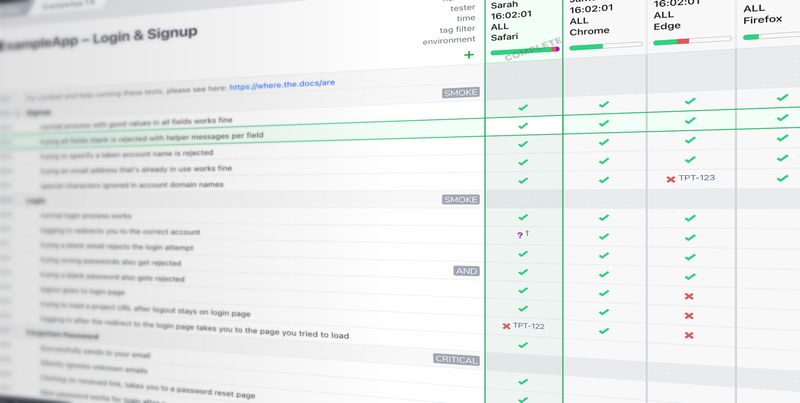
In Testpad, a test is one line of plain text; indentation groups related tests into a hierarchy
Maintain as you go: review after each release, add a test for every bug fixed, delete what's stale
Most guides push formal formats with multiple required fields, elaborate metadata, and step-by-step instructions for every possible action. At Testpad, we think that level of detail creates more work than it saves for most teams; this guide covers what test cases need and what they don't.
What is a test case?
A test case is a single test instruction. One thing to check as part of testing your software.
That instruction might be a brief prompt – "check login with valid credentials" – or a more detailed set of steps with expected outcomes. Both are test cases. The format depends on who's testing, how well they know the product, and how much guidance they need.
Cem Kaner's classic paper What Is a Good Test Case? quotes the IEEE standard definition ("a set of test inputs, execution conditions, and expected results developed for a particular objective") and then makes the more useful point: test cases help us discover information. The format only matters as far as it serves that.
At Testpad, we use the term test prompts rather than test cases. The idea is the same – an instruction for what to test – but the emphasis is on keeping things outcome-focused rather than prescriptive. Instead of spelling out every step, a test prompt points testers at what to investigate and trusts them to use their judgment. It's a deliberately lighter approach, and it works well for teams doing regular release testing or exploratory work.
At minimum, a test case needs to be clear enough that the right person can act on it.
In practice, most test cases benefit from three things:
A clear title – what is being tested, in plain language
Any necessary context – preconditions, environment, or user role if relevant
The expected outcome – what "pass" looks like
The more formal version also includes steps to execute, test data, priority, and metadata like affected components or linked requirements. In Testpad, you can add all of that when a test calls for it: use indentation to build groups of rows that define your test cases – a title row, some rows for each step, some rows for expected outcomes, and more if you need to give preconditions. For most tests, you won't need any of it. A short prompt with a clear outcome is enough to direct a tester's attention and record a meaningful result.
How detailed should a test case be?
As detailed as it needs to be, and no more. The instinct to add detail comes from a good place. More detail feels safer. But detailed test cases take longer to write, longer to read, and significantly longer to maintain. When your product changes, every overly specific step becomes something to update.
If your tester knows the product, keep test cases short. A one-line prompt is enough. If your tester is unfamiliar with the product – a new joiner, a client doing UAT, a guest tester – more detail helps them know what to do.
In Testpad, you adjust detail test by test within the same script. A test is one line of plain text; where one needs spelling out, indent a few rows beneath it for the steps and expected outcomes. Most lines stay brief.
How do you write test cases in practice?
Test case creation doesn't need a template or a formal process. Five steps cover it.
1. Get the ideas down first
Before worrying about format, get the ideas down. What are the most important things to check? Start with the main features and core user flows – login, key actions, anything that would be embarrassing to break.
In Testpad, this usually means opening a new script and typing out a rough list. A rough list that exists is more useful than a polished template waiting to be filled in.
2. Write for outcomes, not actions
The most common test case mistake is describing every click rather than the outcome you're checking.
Instead of: "Click the login button, enter username 'test@example.com', enter password '12345', click submit, verify you see the dashboard"
Write: "Valid credentials log in successfully"
The second version trusts the tester to know how to log in. It focuses on what matters – does it work? – and stays useful even if the UI changes. This is the thinking behind Testpad's test prompt approach: point testers at the outcome, let them figure out the path.
3. Pick the edge cases worth testing
Edge cases matter, but you don't need to test every conceivable one. Focus on edges that are reasonably likely to happen and would cause real problems if they failed – invalid inputs, empty states, boundary values, things that have broken before.
4. Group tests logically
Organize test cases by feature, user flow, or area of the product – whatever makes it easy to see what's covered and what isn't. In Testpad, indenting a line nests it under the one above, so related tests group under a heading, and folders and scripts handle the bigger divisions. You get a clear hierarchy without any extra configuration.
5. Review and trim
Once you have a draft list, read back through it. Are there duplicates? Tests so obvious they add no value? Steps that are really one test written twice? Cut them. A shorter list that gets used is more valuable than a long one that doesn't.
When do more detailed test cases make sense?
Testpad isn't against detailed test cases. Some situations call for them:
Regulated environments like healthcare and finance often require detailed test documentation for compliance. The FDA's General Principles of Software Validation, for instance, expects documented test plans and test cases covering inputs, procedures, and expected results
UAT with clients – when a client is signing off on a deliverable, a detailed test case gives them a clear path to follow
Complex multi-step processes that are hard to describe without step-by-step instructions
Outside of these situations, shorter is usually better. The goal is to find problems before users do.
What's the difference between a test case and a test prompt?
A traditional test case is a formal document with prescribed fields – title, preconditions, steps, expected outcomes, and metadata. It's built for completeness and traceability.
A test prompt is Testpad's lighter version: a specific instruction that points testers at what to investigate without prescribing every step. The tester brings judgment to how they check it – the stance James Bach and Michael Bolton take in Exploratory Testing 3.0, where testing means evaluating a product by learning about it through exploration and experimentation.
The practical difference is speed. Prompts are faster to write, easier to maintain, and leave more room for testers to find things a step-by-step approach would miss. For teams without a formal QA function – developers, product managers, or small teams sharing testing responsibilities – that difference matters.
How many test cases do you need?
Enough to cover the things that matter. There's no target number. A focused set of 30 test cases covering your critical paths is more valuable than 300 that include things nobody reads. Quality of coverage matters more than quantity.
Testpad's starting point: every important user journey, every area that's changed in the current release, and every bug that's been fixed and could plausibly come back.
How do you maintain test cases over time?
Test cases age. Features change, the UI changes, and test cases written six months ago start pointing at things that no longer exist.
A few habits that help:
Review after each release – flag anything that felt out of date during testing
Add as you go – when you find a bug, add a test for it before you forget
Delete without guilt – if a test case is no longer useful, remove it
Keep them short – the shorter the test case, the less there is to update
In Testpad, duplicating a script for a new release copies the tests but not the results. Your test library stays current without starting from scratch each time. See how Testpad handles retesting from build to build.
Write your first test cases in Testpad
In Testpad, a script is your test plan: a checklist of everything you want to cover in a release. You open one, write down the first few things you want to check, and go from there. Testpad works just as well with a short list as it does with a detailed, organized test plan – you add structure as you need it.