Exploratory Testing with something to show for it
Charters as checklists. Reports that show what was and wasn't covered. The freedom to find the bugs that matter.







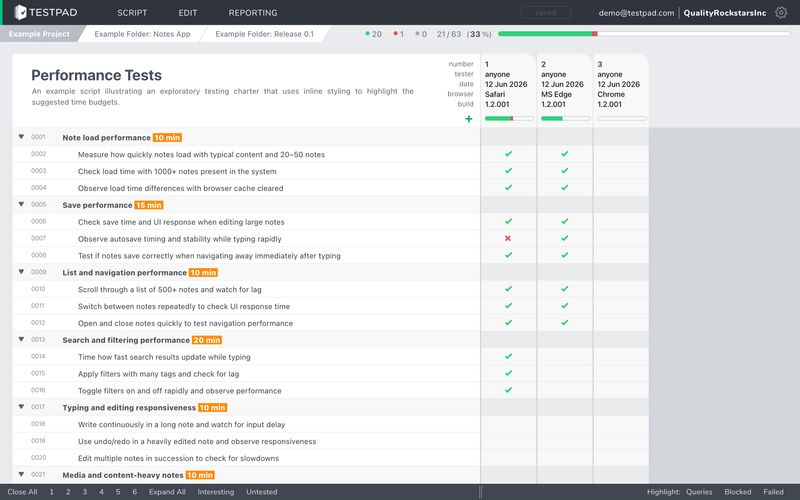
Charters as checklists
In Testpad a charter is a checklist: prompts for the areas to dig into and the ideas worth trying, each one a line of plain text. A prompt can be two words or a whole scenario, as much detail as each idea needs. How to test each one is up to the tester.
The plan steers the session without over-scripting it. Testers work down the checklist, explore within each prompt, and mark what they find as they go.


“Testpad has really made writing test plans a breeze for our team. It helps us to dive into our tests, isolate defects, and provide context around the results.”

Luke Hefson
Engineering Manager, GitHub
Reports that show what was and wasn't covered
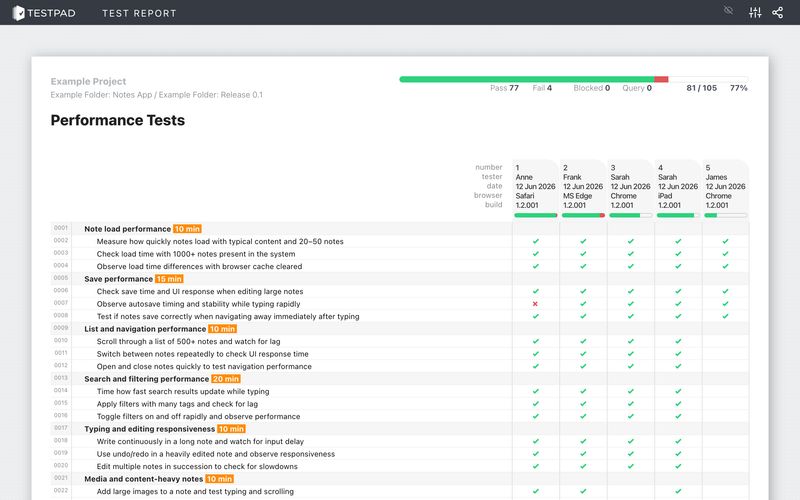
The classic objection to exploratory testing is proving what was tested. Session-based test management is the formal answer. Testpad is the pragmatic one. Every prompt carries a result as you explore, so the report assembles itself: what was covered, what was found, and what nobody got to.
Share it as a link, save it as HTML, or print as PDF. It answers 'are we there yet?' with a quick glance.
“Testpad is flexible enough to create and reuse test plans lightning fast. This helps our team spend more time preparing to test, do the actual testing and report the final results.”

Jason Hamilton
Founder and CEO, TestLauncher
Test plans you can edit during testing
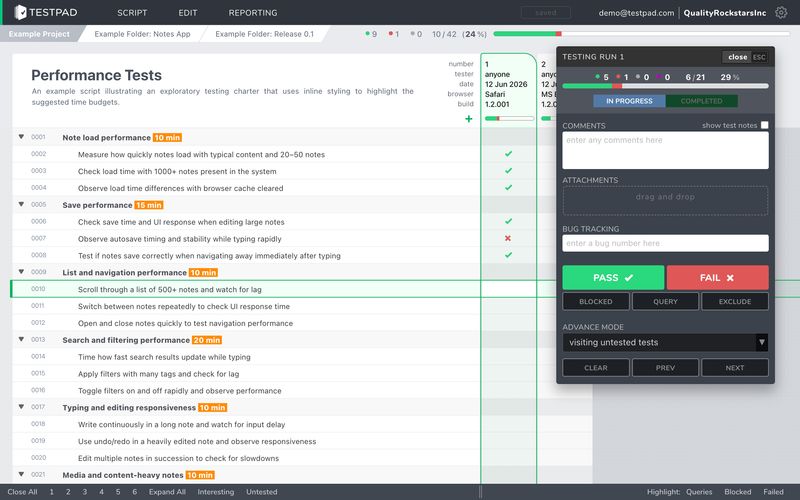
Test plans in Testpad are editable during testing, so when a new idea occurs to you mid-session you add it as a line right where you are and keep going. That matters in exploratory work, because most of the ideas arrive while you're looking.
The additions stay in the plan, so the next release starts from everything earlier sessions taught you instead of a blank page. And when a session wants extra hands, send a guest link: anyone can join from a browser, no login, and their results sit alongside everyone else's.
























USED DAILY BY

QA Teams
Developers
Product Teams
Where exploratory testing fits in Testpad
Time-boxed session charters
When you give each session an hour and a focus
The script is the charter: a checklist of prompts to explore within, grouped under headings. Like a paper charter, every part can carry a time budget: an annotation like [20 mins] against a heading does the job. Results and notes go on the lines as you test, so the debrief is a glance at the report, not a read-through of session notes.
First pass over a new feature
When it's fresh from the branch and nobody scripted anything
Start with the ideas you already have: edge cases, odd inputs, the workflows the spec forgot. More turn up once you're actually looking, so add them to the checklist as you go. Anything that breaks becomes a line in the regression plan, and the feature's first exploration seeds its long-term coverage.
Pre-release bug hunts
When the whole team piles on before the ship date
A bug hunt usually has no plan at all. Build an outline of the main areas you want the team to look at, give everyone a column, and send guest links to whoever's joining in. Everyone sees what's been tried already, so the effort spreads across the product instead of clustering on the login form.
Alongside your automation
When the suite is green and you still don't trust it
Automation checks the paths you knew to script. Exploratory sessions cover the rest: the human pass that catches what nobody thought to automate, with a record that stands next to your CI results.
PRICING
What Testpad costs
Essential
$49 $59
per month, billed annually per month, billed monthly
A basic account for 1, 2 or 3 testers

Team
$99 $119
per month, billed annually per month, billed monthly
Fully featured, for teams up to 10 testers
Team 15
$149 $179
per month, billed annually per month, billed monthly
Fully featured, for teams up to 15 testers
Department
$249 $299
per month, billed annually per month, billed monthly
Fully featured, for teams up to 25 testers
Every plan begins with a fully featured 30-day free trial, no credit card required. Bigger team? Custom plans with invoicing are available.
16 years, 1000s of customers and
over 100 million test results
“Testpad has really made writing test plans a breeze for our team. It helps us to dive into our tests, isolate defects, and provide context around the results.”
 Luke Hefson
Engineering Manager, GitHub Testpad customer for 12 years
“In the past we used other test repositories but they were cumbersome and harder to use than a simple spreadsheet. For us, Testpad combines the visibility and quickness of a spreadsheet with a nice UI.”
 Stewart Warner
Managing Director, Foxhole QA Testpad customer for 7 years
“Testpad is flexible enough to create and reuse test plans lightning fast. This helps our team spend more time preparing to test, do the actual testing and report the final results.”
 Jason Hamilton
Founder and CEO, TestLauncher Testpad customer for 11 years
“Testpad allows for rapid testing to fix issues in our software before it reaches our customers. The simplicity makes the testing process straight forward, gets the results to the engineering team, and is fun for the tester.”
 Brian Grau
Head of Production, OpenROV Testpad customer for 11 years
“Our QA team was lacking the time to write proper regression tests. We already had a much more complex and expensive tool which we never used. Then we gave Testpad a trial and the results were great.”
 Vincent Kurutza
Head of QA, Digital Genius Testpad customer for 9 years
“We couldn't have ramped up our development schedule without Testpad. It's a core part of our QA and the Testpad team are exceptionally responsive.”
 Ashleigh Lodge
Dev Lead, Neovation Learning Solutions Testpad customer for 12 years
Common questions
Is Testpad a session-based test management tool?
A lightweight one. Charters and their prompts map naturally onto Testpad's outline, results and notes record against each line, and reports show coverage per session. There are no timers or session metrics; teams that want the full SBTM ceremony usually pair Testpad with their own timebox.
Isn't structure the opposite of exploratory testing?
Pure improvisation is hard to defend and hard to repeat. A checklist of prompts guides attention without prescribing steps: it says where to look, never how. The exploring stays yours. Think of it as pragmatic exploratory testing.
How do I record what happened in a session?
Mark results against each prompt as you go, add comments for anything interesting, attach screenshots where they help, and add new lines for the tests you invented on the spot. The session's story ends up in the plan itself.
Can managers see what was covered?
Yes, that's half the point. Reports show what was explored, what passed and failed, and what's still untouched, shareable as a guest link or saved as HTML or a PDF.
Does this replace scripted or automated testing?
No. Most teams run exploratory sessions alongside scripted checklists and automation, and the same Testpad project holds the regression plans too.
Where can I read more about exploratory testing?
We keep a full guide to exploratory testing on the blog: what it is, the main techniques, and how teams organize it.
How much does Testpad cost?
Plans are flat-rate: the Essential plan is $49 a month billed annually ($59 month-to-month) for up to 3 testers, and fully featured team plans with image attachments and guest testing start at $99 a month for 10 testers. Every plan starts with a free 30-day trial, no credit card required.
Put your next exploratory session in Testpad instead of a notes app.
A checklist of prompts is all the plan you need.

NO SOFTWARE DOWNLOADS
NO CREDIT CARDS
NO SHENANIGANS