he difference between Testpad and Zephyr is structural, and it's worth understanding before you pick either tool. Zephyr builds test management on top of Jira; Testpad uses a checklist of plain text prompts in a standalone tool. This page sets out that difference, where each tool is stronger, and how the costs compare, so you can decide which fits the way your team tests.
The short version
- Zephyr is two Jira-based products. In Zephyr Squad (now Essential), a test is a Jira issue. In Zephyr Scale, tests live in the app's own repository, linked to Jira issues. Either way you work inside Jira. In Testpad, a test is a line of plain text in a checklist, in its own tool, outside Jira.
- Teams choose Zephyr to keep testing inside Jira, with traceability from requirements through tests to defects. Teams choose Testpad for fast manual and exploratory testing, a guest-testing feature, and a tool that stands on its own.
- Zephyr's strength is being part of Jira. That is also its cost: you work through Jira, it bills on your total Jira user count rather than just your testers, and bringing in someone who isn't in Jira is hard.
- Testpad is from $10/user/month, and guest testers are free. Zephyr is priced by how many Atlassian users are on your Jira instance.
- Neither choice is wrong. It comes down to whether you want your test tool to run within the Jira ecosystem, or whether you want it light and standalone.
What's the actual difference?
Zephyr is built into Jira. Both editions assume Jira and run inside it. In Zephyr Squad (renamed Zephyr Essential), test cases, test cycles and executions are Jira issue types, stored in Jira itself. In Zephyr Scale, tests sit in a dedicated repository with folders, reusable steps, parameters and versioning, linked back to Jira issues for coverage. Because testing lives in or beside Jira, it shows up against your stories, in your boards and in Jira reporting, and a failing test is one click from a linked defect. Zephyr builds requirement coverage on those links, supports Cucumber and Gherkin for BDD, and pipes automated results in from CI. What you get, and what you maintain, is testing modeled as Jira-linked test cases.
Testpad is built around the test plan, on its own. A test is a line of plain text. Indenting builds the plan's structure: group related tests under a heading, or spell a bigger test out over several lines. Add a column for each test run, and mark each prompt pass or fail as you go. There's no Jira to set up and no issue type to configure. You write the way you think, share the plan with a link, and anyone, in Jira or not, can run it.
If you live in Jira and want your tests to live there too, Zephyr's model is the point. If you'd rather a test stayed a checklist item, and your testers didn't all need Jira accounts, that's the gap Testpad fills.
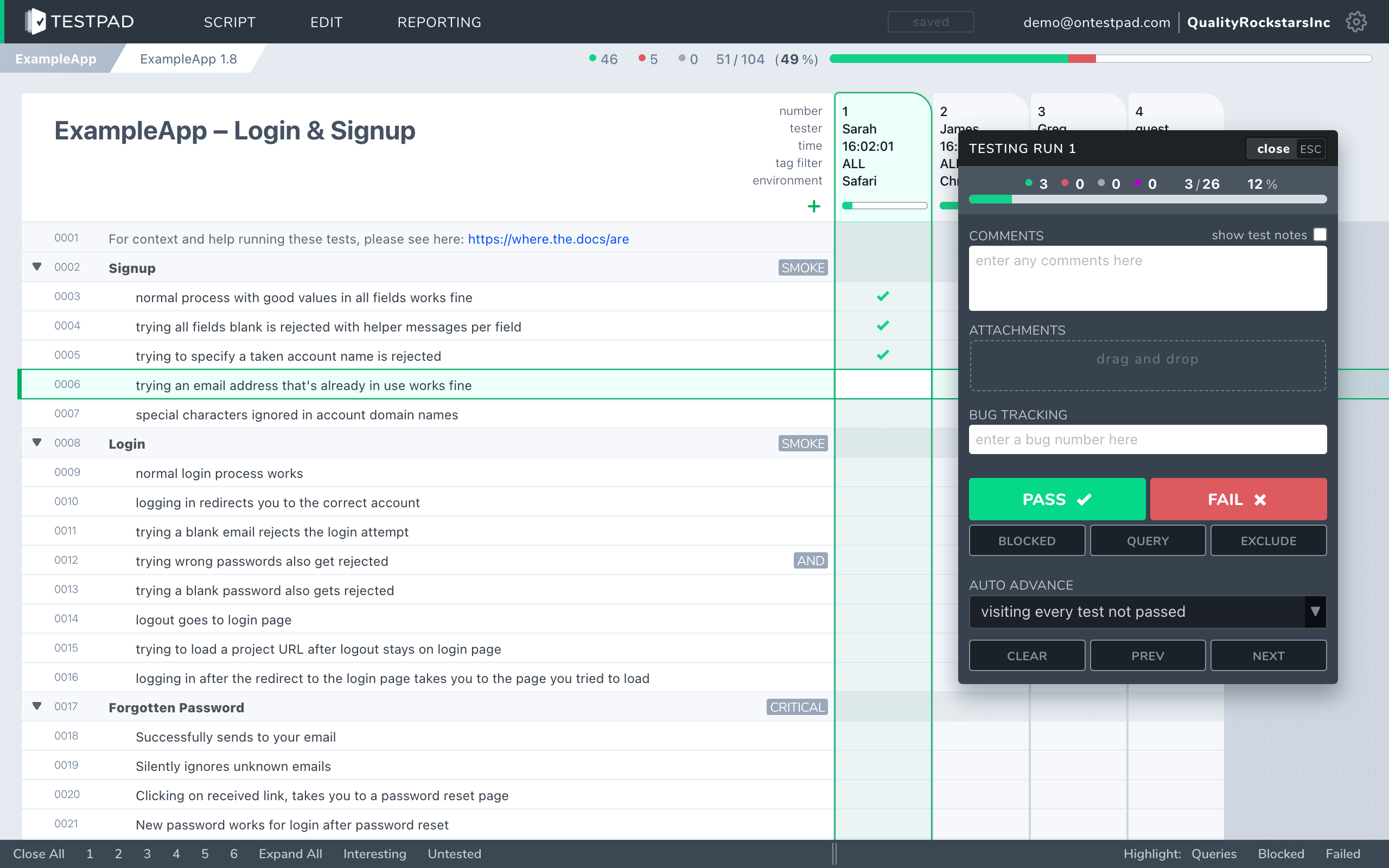
How do Testpad and Zephyr compare?
A side-by-side comparison of the aspects that matter when choosing.
| Testpad | Zephyr |
|---|
| Data model | A test plan: a nested outline of plain-text prompts that read like a checklist, with a column per run | Test cases in Jira: Jira issues in Zephyr Squad, or a linked test repository with reusable steps and parameters in Zephyr Scale |
| Where it runs | Its own web app; nothing to install | Inside Jira (Cloud or Data Center); no standalone use |
| Time to first test | Minutes; write a line and you're testing | Longer; set up the Jira project and Zephyr, then define structured test cases |
| Writing tests | Type a line, hit enter, repeat | Create a structured test case with steps and expected results; BDD via Cucumber and Gherkin in Scale |
| Guest / UAT testers | Share a link; no login, no seat, not in Jira | Testers work in Jira, so they generally need Jira access |
| Requirement traceability | Lightweight: clickable issue links | Deep: requirement to test to execution to defect coverage, inside Jira |
| Automation / BDD | Push results from CI via the REST API; Gherkin syntax supported | First-class: Cucumber and Gherkin, CI hooks, automated results recorded against Jira |
| Reports | An instant link, shareable with anyone | Jira dashboards plus Zephyr's own reports; advanced and cross-project reporting on higher tiers |
| Audit trail / permissions | Not today | Via Jira: issue history, permissions, audit logs |
| Pricing | From $10/user/month, guest testers free | By total Jira user count: free for up to 10 Atlassian users on Zephyr Scale, then about $5.62 per user monthly per extra user |
| Best for | UAT, regression, exploratory, ad-hoc, hardware bring-up, dev-led testing | Jira-centric teams, deep traceability, regulated QA, large structured test suites |
Zephyr facts checked against its Atlassian Marketplace listing and SmartBear's product pages, June 2026.
Why do teams choose Testpad over Zephyr?
Testers don't need to be in Jira. In Zephyr, testing happens in Jira, so anyone who runs or records a test works in Jira and generally needs an account. Send a Testpad plan as a link to a client, a freelancer, or a non-technical coworker, and they're testing in minutes: no login, no seat, no Jira account. For UAT and outside testers, that means no Jira seats to buy and no accounts to set up.
It stands on its own. Testpad doesn't assume Jira. If your team isn't all in Jira, or you'd rather your test data didn't live inside it, Testpad is a tool in its own right: write plans, run them, share reports, done.
Less to set up and maintain. No project configuration, issue types or test-case forms before you can write a test. A plan is an outline you add a column to, so it stays light as testing grows.
Write-as-you-think speed. No structured test-case form per test. Type a prompt, hit enter, type the next. One customer described it as "just like writing… feels like you're writing a document".
Cost that follows your testers, not your whole Jira org. Zephyr bills on your total Jira user count, so every developer, product manager and designer on the instance counts toward the price whether they ever run a test or not. Testpad charges for the people testing in Testpad.
Exploratory and ad-hoc, out of the box. Exploratory testing suits a checklist plan: set a scope, then explore within each prompt and record what you find. Zephyr's structured, step-by-step test cases assume you know the test before you run it.
When is Zephyr the better choice?
When your team lives in Jira and you want testing to live there too. Tests linked to Jira give you requirement-to-defect traceability inside the tool your developers already use, coverage you can see on a Jira board, and the audit history that regulated work depends on. It handles manual and automated testing together, with strong Cucumber and BDD support and broad CI integration, and Zephyr Scale's reusable, parameterized, versioned test cases hold up across large suites and multiple projects. If your process depends on that traceability, or on testing being part of Jira rather than beside it, Zephyr is built for the job, and you'd likely be happier there. To see the wider field, our guide to Zephyr alternatives covers it.
When is Testpad the better choice?
When you want testing to be light and fast, and open to people who aren't in Jira. You run UAT with clients or freelancers, do regression and exploratory work, test hardware, or your developers test their own code and a structured test case per check is more ceremony than the testing needs. Teams of that shape get going in minutes, keep the plan light enough to stay current, and don't pay for testing seats they only hand out for a two-week burst.
"We use Testpad to track all of our testing. It offers the depth and flexibility to model our entire test plan, but remains simple enough that onboarding new testers is effortless. The import and export facilities are really helpful for migrating test plans from other test management tools."
Eric Wolf, Senior Solutions Architect, Bell
Common questions
Is Testpad a replacement for Zephyr?
For lightweight, fast manual testing it can be: UAT, regression, exploratory, hardware, dev-led testing, checking AI output. If your testing depends on living inside Jira with deep requirement-to-defect traceability and audit history, that's what Zephyr is for, and Testpad doesn't replace it.
What's the actual difference in the data model?
Zephyr stores test cases in Jira: as Jira issues in Zephyr Squad, or as a linked repository of structured test cases in Zephyr Scale. Testpad stores a test plan as a standalone nested outline of plain text prompts, with a column added per test run.
Does Testpad work without Jira?
Yes. Testpad is its own web app and doesn't need Jira or any tracker. Both Zephyr editions run inside Jira.
Does Testpad integrate with Jira?
Lightly. Set your tracker's URL pattern once and every issue ID you type in Testpad becomes a clickable link to the issue in Jira (or GitHub, Trello, and the like). There's a REST API for pushing automated results from CI. Outbound webhooks notify your other tools when runs finish or results change, directly or through Zapier and the like. There's no two-way sync and no coverage view inside Jira; Zephyr, being part of Jira, has those.
Can clients or non-technical people test in Testpad?
Yes. Share a link and a guest tests with no login, no seat, and no Jira account. Because Zephyr's testing happens in Jira, the same people would generally need Jira access.
How does pricing compare?
Testpad is from $10/user/month, and guest testers are free, charged for the people testing in Testpad. Zephyr is priced by your total Atlassian user count: free for up to 10 users on Zephyr Scale, then scaling with every Jira user on the instance, not just your testers.
Does Testpad handle BDD or automated tests?
Testpad supports Gherkin-style syntax for BDD-flavored plans and takes automated results from CI through its REST API. It doesn't run automation itself. Zephyr's Cucumber execution and automation integration go deeper; if that's central to your work, Zephyr does more.
Does Testpad have an audit trail or per-user permissions?
Not today. Zephyr inherits Jira's issue history, permissions and audit logs; if your process requires those, check before you migrate anything.
See the difference in five minutes
The fastest way to choose is to write a real test plan in each. Testpad's free 30-day trial includes all features and up to 20 users, with no credit card and nothing to install. And no Jira required: paste in a chunk of your existing tests and see how they read as a standalone checklist.